Android Studio Hub

On-page SEO Optimization – Improve Content & Structure for Better Rankings

On-page SEO is the practice of optimizing individual web pages to rank higher and earn more relevant traffic. From meta tags and headings to internal linking and content formatting, these strategies ensure your site is both search engine-friendly and user-focused.

SEO Guide – Fundamentals, Strategies & Tools

What is On-page SEO?

On-page SEO refers to all the elements you can control directly on your website to improve search visibility. This includes optimizing meta tags, headings, keyword placement, internal linking, and content structure. By following on-page SEO best practices, you make your site easier for search engines to understand and more engaging for users.

Explore Our Complete SEO Guide

Navigate through our comprehensive modules covering every aspect of On-page SEO

SEO

the process of optimizing your website to increase its visibility in search engine results pages (SERPs)

SEO Fundamentals

Learn the basics of search engine optimization and how it works.

Technical SEO

Improve site performance, speed, and crawlability for search engines.

Keyword Research

Find high-value keywords that drive targeted traffic to your site.

Content Optimization

Align content with search intent and maximize engagement.

Link Building

Build authority & trust through strategic backlink acquisition.

Writing & Formatting

Craft SEO-friendly text that ranks well and converts readers.

Blog Setup & Platforms

Launch your blog easily with the right platform and configuration.

Monetization Strategies

Turn traffic into revenue with proven monetization tactics.

Promotion & Analytics

Track & grow performance with data-driven insights and tools.

Featured Tutorials

Common questions about optimizing content and structure for better rankings

Latest SEO Trends

VPN encrypting torrent traffic on laptop screen with secure global connection.
Read More
TikTok Shop global ecommerce trend 2025 visual with world shopping elements
Read More
Cloud IDE setup showing Android Studio coding across laptop, smartphone, tablet, and browser
Read More
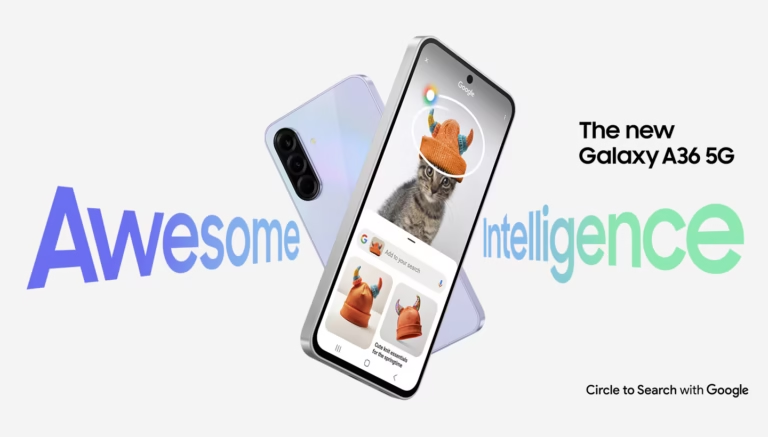
Galaxy a36 5G
Read More

On-page SEO FAQ

Common questions about optimizing content and structure for better rankings

On-page SEO focuses on optimizing elements within your website, while off-page SEO involves external factors like backlinks and social signals.

    1. Focus on one primary keyword and a few related secondary keywords. Avoid keyword stuffing; instead, use them naturally in headings, meta tags, and content.
  • Do meta descriptions affect SEO rankings?
    Meta descriptions don’t directly influence rankings, but they improve click-through rates, which can indirectly boost performance.
  • Should I use multiple H1 tags on a page?
    Best practice is to use a single H1 tag per page, supported by H2 and H3 tags for structure.
  • How important is internal linking for on-page SEO?
    Internal links help search engines crawl your site and guide users to related content, improving both visibility and engagement.

✅ This content is tailored for the On-page SEO subpage while keeping the same design framework you already have.

Would you like me to proceed with the Technical SEO subpage content next, following the same structure (Hero → Question Block → FAQ)?

Meta descriptions don’t directly influence rankings, but they improve click-through rates, which can indirectly boost performance.
On-page SEO refers to optimizations you make on your own website (content, meta tags, site structure). Off-page SEO involves external factors like backlinks from other sites, social signals, and brand mentions. Both are essential for comprehensive SEO success.
Best practice is to use a single H1 tag per page, supported by H2 and H3 tags for structure.
Internal links help search engines crawl your site and guide users to related content, improving both visibility and engagement.